UFC veteran and current Bellator lightweight Roger Huerta beat down a man during a weekend street fight in Austin, Texas after the man sucker punched a woman during a scuffle.
In a video released by TMZ, Huerta confronts the man for knocking the woman down with a punch to the head and ends with Huerta leaving the man beaten on the ground.
No charges have been filed.

UFC veteran and current Bellator lightweight Roger Huerta beat down a man during a weekend street fight in Austin, Texas after the man sucker punched a woman during a scuffle.
In a video released by TMZ, Huerta confronts the man for knocking the woman down with a punch to the head and ends with Huerta leaving the man beaten on the ground.
No charges have been filed.

Omar Thornton, the Hartford Distributors, Manchester, Ct shooting suspect was reported to be "not violent" according to his former girlfriend Kristi Hannah. She also said he was the target of racism at the workplace.
That does not in any way excuse what Omar did, but it serves as a warning sign regarding what can push a person to the edge. If it was racism that pushed Omar, then that should be studied so that such a climate is not allowed to exist in the workplace.
Reportedly offered the chance to quit or be fired from the beer distributor because he was an alleged discipline problem according to a Teamsters Union Official, 34-year-old Omar Thornton opened fire and hit eight people, seven have died and one was critically injured according to news updates.
Thornton was the last to die, and according to HLN on television, he called his mother to say "goodbye" after he shot the employees (UPDATE: CBS reports he said to his mother he "killed the five racists who were bothering" him). But how he died is still a source of conflicting reports: some say he was killed by police officers when he refused to drop his gun and others claim that Thornton turned the gun on himself.
Whatever the case, it's clear Omar Thornton snapped. His former girlfriend said he was not a violent person. While he purchased two guns, Omar Thornton had a legal gun permit, and was going to teach his girlfriend how to use guns, according to the Associated Press.
Teamsters official Christopher Roos is wrong about race
Teamsters official Christopher Roos said the shootings had nothing to do with race because Omar Thornton never filed a complaint with the union or any government agency. But what Mr. Roos didn't consider is that some people don't know where to go to file a complaint of racism.
Teamsters official Christopher Roos' statement that "it had nothing to do with race" is both cowardly and irresponsible and wrong. What's the fear in saying that it did have to do with race, when apparently it did? To avoid the chance that maybe they did something to make Omar Thornton snap? Saying that what Omar Thornton did was awful is obvious. But there's a less to be learned here that's being covered up thus far.
Thornton's girlfriend said that he, to quote the Houston Chronicle, "complained of racial harassment and said he found a picture of a noose and a racial epithet written on a bathroom wall." When that happens at work, some people don't know what to do. Perhaps that was the case with Thornton.
But obviously Thornton had also not been instructed on how to deal with race. If he were made to be a mentally stronger person, this story would not have happened. African Americans have been the victims of racism for centuries, but we're not known for killing anyone as a reaction to it. This is disturbing.
There's is much to know, still. What was the discipline problem (on HLN the allegation was theft)? Did he have any friends within the ranks of the Hartford Distributors beer distributor company? Why did he break from his girlfriend of eight months?
A very sad story of a person who went on a rampage and killed people he worked with.
Omar Thornton, the Hartford Distributors, Manchester, Ct shooting suspect was reported to be "not violent" according to his former girlfriend Kristi Hannah. She also said he was the target of racism at the workplace.
That does not in any way excuse what Omar did, but it serves as a warning sign regarding what can push a person to the edge. If it was racism that pushed Omar, then that should be studied so that such a climate is not allowed to exist in the workplace.
Reportedly offered the chance to quit or be fired from the beer distributor because he was an alleged discipline problem according to a Teamsters Union Official, 34-year-old Omar Thornton opened fire and hit eight people, seven have died and one was critically injured according to news updates.
Thornton was the last to die, and according to HLN on television, he called his mother to say "goodbye" after he shot the employees (UPDATE: CBS reports he said to his mother he "killed the five racists who were bothering" him). But how he died is still a source of conflicting reports: some say he was killed by police officers when he refused to drop his gun and others claim that Thornton turned the gun on himself.
Whatever the case, it's clear Omar Thornton snapped. His former girlfriend said he was not a violent person. While he purchased two guns, Omar Thornton had a legal gun permit, and was going to teach his girlfriend how to use guns, according to the Associated Press.
Teamsters official Christopher Roos is wrong about race
Teamsters official Christopher Roos said the shootings had nothing to do with race because Omar Thornton never filed a complaint with the union or any government agency. But what Mr. Roos didn't consider is that some people don't know where to go to file a complaint of racism.
Teamsters official Christopher Roos' statement that "it had nothing to do with race" is both cowardly and irresponsible and wrong. What's the fear in saying that it did have to do with race, when apparently it did? To avoid the chance that maybe they did something to make Omar Thornton snap? Saying that what Omar Thornton did was awful is obvious. But there's a less to be learned here that's being covered up thus far.
Thornton's girlfriend said that he, to quote the Houston Chronicle, "complained of racial harassment and said he found a picture of a noose and a racial epithet written on a bathroom wall." When that happens at work, some people don't know what to do. Perhaps that was the case with Thornton.
But obviously Thornton had also not been instructed on how to deal with race. If he were made to be a mentally stronger person, this story would not have happened. African Americans have been the victims of racism for centuries, but we're not known for killing anyone as a reaction to it. This is disturbing.
There's is much to know, still. What was the discipline problem (on HLN the allegation was theft)? Did he have any friends within the ranks of the Hartford Distributors beer distributor company? Why did he break from his girlfriend of eight months?
A very sad story of a person who went on a rampage and killed people he worked with.
Mitch Miller, an influential record producer who became a hugely popular recording artist and an unlikely television star a half century ago by leading a choral group in familiar old songs and inviting people to sing along, died on Saturday in Manhattan. He was 99.
His daughter Margaret Miller Reuther confirmed the death Monday morning, saying her father had died after a short illness at Lenox Hill Hospital. Mr. Miller lived in Manhattan.
Mr. Miller, a Rochester native who was born on the Fourth of July, had been an accomplished oboist and was still a force in the recording industry when he came up with the idea of recording old standards with a chorus of some two dozen male voices and printing the lyrics on album covers.
The “Sing Along With Mitch” album series, which began in 1958, was an immense success, finding an eager audience among older listeners looking for an alternative to rock ’n’ roll. Mitch Miller and the Gang serenaded them with chestnuts like “Home on the Range,” “That Old Gang of Mine,” “I’ll Take You Home Again, Kathleen” and “It’s a Long Way to Tipperary.”
When the concept was adapted for television in 1961, with the lyrics appearing at the bottom of the screen, Mr. Miller, with his beaming smile and neatly trimmed mustache and goatee, became a national celebrity.
By then he had established himself as a hit maker for Columbia Records and a career shaper for singers like Tony Bennett, Rosemary Clooney, Johnny Mathis, Doris Day, Patti Page and Frankie Laine. First at Mercury Records and then at Columbia, he helped define American popular music in the postwar, pre-rock era, carefully matching singers with songs and choosing often unorthodox but almost always catchy instrumental accompaniment.
Mr. Bennett’s career took off after Mr. Miller persuaded him to record the ballad “Because of You,” backing him with a lush orchestral arrangement by Percy Faith. It reached No. 1 on the pop charts in 1951.
Ms. Clooney was making a mere $50 a recording session when Mr. Miller asked her to record “Come On-a My House,” an oddity based on an Armenian folk melody written by the playwright and novelist William Saroyan and his cousin Ross Bagdasarian, who later went on to create Alvin and the Chipmunks. Ms. Clooney was dubious. “I damn near fell on the floor,” she recalled.
They had a heated argument. But in the end Ms. Clooney agreed to record the song, and it became a giant hit, establishing her as a major artist.
“Nothing happened to me until I met Mitch,” she later said.
By the end of the 1950s Mr. Miller’s eye and ear for talent and songs had been critical in making Columbia the top-selling record company in the nation.
Mr. Miller was the Midas of novelty music, storming the charts with records like Jimmy Boyd’s “I Saw Mommy Kissing Santa Claus and providing singers with unusual instrumental backing: a harpsichord for Ms. Clooney, French horns for Guy Mitchell. One of his earliest hits, “Mule Train,” was recorded by the muscular-voiced Frankie Laine with three electric guitars, and Mr. Miller himself using a wood block to simulate the snapping of a whip.
Mr. Miller was a studio innovator. Along with the guitarist Les Paul and a few others, he helped pioneer overdubbing, the technique by which different tracks are laid over one another to produce a richer effect; he employed it memorably with Ms. Page, whose close-harmony “duets” with herself became her signature. He also achieved what he called a sonic “halo” on numerous recordings by the use of what came to be called an echo chamber — actually an effect an engineer produced by placing a speaker and a microphone in a tiled restroom.
One Miller specialty was developing crossovers from country to pop. He had particular success with Hank Williams’s songs: he transformed “Hey, Good Lookin’ ” into a hit for Mr. Laine and Jo Stafford and did the same for Mr. Bennett (“Cold, Cold Heart”), Ms. Clooney (“Half as Much”) and Ms. Stafford on her own (“Jambalaya”).
His touch was not always sure. When he had bagpipes accompany Dinah Shore on a song called “Scottish Samba” the result was, in Mr. Miller’s own words, “a dog.” And probably the nadir of Frank Sinatra’s recording career came after Mr. Miller left Mercury and took over pop production at Columbia in 1950.
Sinatra complained that Mr. Miller forced him to record inferior material like “Bim Bam Baby,” “Tennessee Newsboy” and, perhaps most notoriously, “Mama Will Bark,” a 1951 novelty duet with the television personality Dagmar that included dog imitations. Sinatra even sent a telegram to a Congressional subcommittee complaining that Mr. Miller had denied him “freedom of selection.” (Sinatra did sometimes veto Mr. Miller’s song choices. When he refused to record “The Roving Kind” and “My Heart Cries for You,” Mr. Miller replaced him in the studio with a young singer named Guy Mitchell. Mr. Mitchell’s versions of both those songs became hits and made him a star.)
Interviewed by Time magazine in 1951, Mr. Miller was less than enthusiastic about the kind of gimmicky pop records that had become his specialty. “I wouldn’t buy that stuff for myself,” he said. “There’s no real artistic satisfaction in this job. I satisfy my musical ego elsewhere.”
Mr. Miller came up with the idea for his singalong albums in 1958, drawing on a repertory that ordinary people had sung in churches and parlors for decades. By the time he recorded the first “Sing Along With Mitch” album, he had already had success with this approach on the singles chart, scoring a No. 1 hit in 1955 with an arrangement of “The Yellow Rose of Texas.”
Mitch Miller and the Gang eventually recorded more than 20 long-playing discs, many of which made the Top 40. By 1966 they had sold about 17 million copies.
In 1960 his singalong concept was given a one-time television test on NBC. The response was so favorable that “Sing Along With Mitch” became a mainstay of family television, running — every other week at first, then weekly — from 1961 to 1964, then returning in reruns in the summer of 1966. Viewers were encouraged to sing along and instructed to “follow the bouncing ball” — a large dot that bounced from word to word as the lyrics were superimposed on the screen. Among the singers featured, in addition to the male chorus, was a young Leslie Uggams.
The ratings were good, but the critics were mostly unimpressed. Brooks Atkinson, writing in The New York Times, suggested in 1962 that “Sing Along With Mitch” might best be viewed with the sound turned off.
Even at the singalongs’ height, many Americans considered them hopelessly corny. That sense only intensified as a younger generation came of age in the 1960s and musical tastes changed. There were news reports that shopping malls had begun piping Mitch Miller music on their sound systems as a way to discourage teenagers from congregating. Years later, in 1993, when David Koresh and members of his Branch Davidian cult were holed up in their compound in Waco, Tex., F.B.I. agents tried to flush them out by blasting “Sing Along With Mitch” Christmas carols.
By the time Mr. Miller’s television show left the air, his era of popular music had largely ended with the emergence of rock. He was sympathetic to blues and folk music and had one of his biggest hits in 1951 with Johnnie Ray’s “Cry,” a histrionic performance often cited as a rock ’n’ roll precursor. He had also tried to sign Elvis Presley for Columbia before being outbid by RCA. But he turned down an opportunity to sign Buddy Holly, and he was outspoken in his dislike of rock ’n’ roll in general. “It’s not music,” he was quoted as saying, “it’s a disease.” When Bob Dylan, soon to become one of rock’s most influential artists, joined the Columbia roster in 1961, it was not Mr. Miller but another label executive, John Hammond, who signed him.
Mr. Miller told Audio magazine in 1985 that his opposition to rock ’n’ roll had been based more on principle than on taste. The so-called payola scandal, in which record companies were found to have paid disc jockeys to play rock ’n’ roll records, had dismayed him, he said. He also complained about “British-accented youths ripping off black American artists and, because they’re white, being accepted by the American audience” — although that hardly explained his opposition to rock ’n’ roll in the ’50s, a decade before the advent of the Beatles and other British bands.
His wife of 65 years, the former Frances Alexander, died in 2000.
In addition to his daughter Ms. Miller Reuther, Mr. Miller is survived by another daughter, Andrea Miller; a son, Mitchell; two brothers, Leon and Joseph; two grandchildren and two great-grandchildren.
Mitchell William Miller was born on July 4, 1911, in Rochester, one of five children of Abram Calmen Miller, an immigrant from Russia and a wrought-iron worker, and Hinda Rosenblum Miller, a former seamstress.
Mr. Miller’s own musical career began with the oboe. The composer Virgil Thomson called him “an absolutely first-rate oboist — one of the two or three great ones at that time in the world.”
He took up the oboe almost by chance. Seeking to join the orchestra at Washington Junior High School in Rochester, he showed up late for the tryouts and found it was the only one of the instruments, offered free to students, that had not been claimed.
By the age of 15 Mr. Miller was playing with the Syracuse Symphony. After high school he went to the Eastman School of Music in Rochester, graduating cum laude in 1932.
He played with the Rochester Philharmonic and then made his way to New York City, where he played oboe for a season under David Mannes in concerts at the Metropolitan Museum of Art. He later got a job with the CBS Symphony, performing with it during the notorious Orson Welles “War of the Worlds” radio broadcast in 1938.
He also played in orchestras under Andre Kostelanetz and Percy Faith and performed in another that accompanied George Gershwin on a concert tour as a pianist. When Gershwin’s “Porgy and Bess” opened on Broadway in 1935, Mr. Miller was in the pit orchestra. He continued to play the oboe after he became a record producer, most notably on the recordings the great jazz saxophonist Charlie Parker made with a string orchestra.
Mr. Miller went to work for Mercury Records in the late ’40s, initially as a producer of classical music and then as head of artists and repertory in the pop division. In 1950, at the invitation of a former Eastman classmate, Goddard Lieberson, executive vice president of Columbia Records, he took the equivalent position there. In the early 1950s he was also musical director of Little Golden Records, which made widely popular recordings for children.
After rock came to dominate the record business and the singalong craze ran its course, Mr. Miller left Columbia and ventured into the Broadway theater, with limited success. He produced “Here’s Where I Belong,” a 1968 musical based on John Steinbeck’s “East of Eden,” which closed after one performance. He was later involved in the production of several other Broadway shows, few of them hits. In the 1980s and ’90s he was a frequent guest conductor of symphony orchestras.
“What pleased me the most,” he said in an interview with The Times in 1981, “was a fellow who came up to me after a concert in Chicago and said, ‘You know, there’s nobody in this whole country who hasn’t been touched by your music in some way.’
“That really made me feel good.”

Mitch Miller, an influential record producer who became a hugely popular recording artist and an unlikely television star a half century ago by leading a choral group in familiar old songs and inviting people to sing along, died on Saturday in Manhattan. He was 99.
His daughter Margaret Miller Reuther confirmed the death Monday morning, saying her father had died after a short illness at Lenox Hill Hospital. Mr. Miller lived in Manhattan.
Mr. Miller, a Rochester native who was born on the Fourth of July, had been an accomplished oboist and was still a force in the recording industry when he came up with the idea of recording old standards with a chorus of some two dozen male voices and printing the lyrics on album covers.
The “Sing Along With Mitch” album series, which began in 1958, was an immense success, finding an eager audience among older listeners looking for an alternative to rock ’n’ roll. Mitch Miller and the Gang serenaded them with chestnuts like “Home on the Range,” “That Old Gang of Mine,” “I’ll Take You Home Again, Kathleen” and “It’s a Long Way to Tipperary.”
When the concept was adapted for television in 1961, with the lyrics appearing at the bottom of the screen, Mr. Miller, with his beaming smile and neatly trimmed mustache and goatee, became a national celebrity.
By then he had established himself as a hit maker for Columbia Records and a career shaper for singers like Tony Bennett, Rosemary Clooney, Johnny Mathis, Doris Day, Patti Page and Frankie Laine. First at Mercury Records and then at Columbia, he helped define American popular music in the postwar, pre-rock era, carefully matching singers with songs and choosing often unorthodox but almost always catchy instrumental accompaniment.
Mr. Bennett’s career took off after Mr. Miller persuaded him to record the ballad “Because of You,” backing him with a lush orchestral arrangement by Percy Faith. It reached No. 1 on the pop charts in 1951.
Ms. Clooney was making a mere $50 a recording session when Mr. Miller asked her to record “Come On-a My House,” an oddity based on an Armenian folk melody written by the playwright and novelist William Saroyan and his cousin Ross Bagdasarian, who later went on to create Alvin and the Chipmunks. Ms. Clooney was dubious. “I damn near fell on the floor,” she recalled.
They had a heated argument. But in the end Ms. Clooney agreed to record the song, and it became a giant hit, establishing her as a major artist.
“Nothing happened to me until I met Mitch,” she later said.
By the end of the 1950s Mr. Miller’s eye and ear for talent and songs had been critical in making Columbia the top-selling record company in the nation.
Mr. Miller was the Midas of novelty music, storming the charts with records like Jimmy Boyd’s “I Saw Mommy Kissing Santa Claus and providing singers with unusual instrumental backing: a harpsichord for Ms. Clooney, French horns for Guy Mitchell. One of his earliest hits, “Mule Train,” was recorded by the muscular-voiced Frankie Laine with three electric guitars, and Mr. Miller himself using a wood block to simulate the snapping of a whip.
Mr. Miller was a studio innovator. Along with the guitarist Les Paul and a few others, he helped pioneer overdubbing, the technique by which different tracks are laid over one another to produce a richer effect; he employed it memorably with Ms. Page, whose close-harmony “duets” with herself became her signature. He also achieved what he called a sonic “halo” on numerous recordings by the use of what came to be called an echo chamber — actually an effect an engineer produced by placing a speaker and a microphone in a tiled restroom.
One Miller specialty was developing crossovers from country to pop. He had particular success with Hank Williams’s songs: he transformed “Hey, Good Lookin’ ” into a hit for Mr. Laine and Jo Stafford and did the same for Mr. Bennett (“Cold, Cold Heart”), Ms. Clooney (“Half as Much”) and Ms. Stafford on her own (“Jambalaya”).
His touch was not always sure. When he had bagpipes accompany Dinah Shore on a song called “Scottish Samba” the result was, in Mr. Miller’s own words, “a dog.” And probably the nadir of Frank Sinatra’s recording career came after Mr. Miller left Mercury and took over pop production at Columbia in 1950.
Sinatra complained that Mr. Miller forced him to record inferior material like “Bim Bam Baby,” “Tennessee Newsboy” and, perhaps most notoriously, “Mama Will Bark,” a 1951 novelty duet with the television personality Dagmar that included dog imitations. Sinatra even sent a telegram to a Congressional subcommittee complaining that Mr. Miller had denied him “freedom of selection.” (Sinatra did sometimes veto Mr. Miller’s song choices. When he refused to record “The Roving Kind” and “My Heart Cries for You,” Mr. Miller replaced him in the studio with a young singer named Guy Mitchell. Mr. Mitchell’s versions of both those songs became hits and made him a star.)
Interviewed by Time magazine in 1951, Mr. Miller was less than enthusiastic about the kind of gimmicky pop records that had become his specialty. “I wouldn’t buy that stuff for myself,” he said. “There’s no real artistic satisfaction in this job. I satisfy my musical ego elsewhere.”
Mr. Miller came up with the idea for his singalong albums in 1958, drawing on a repertory that ordinary people had sung in churches and parlors for decades. By the time he recorded the first “Sing Along With Mitch” album, he had already had success with this approach on the singles chart, scoring a No. 1 hit in 1955 with an arrangement of “The Yellow Rose of Texas.”
Mitch Miller and the Gang eventually recorded more than 20 long-playing discs, many of which made the Top 40. By 1966 they had sold about 17 million copies.
In 1960 his singalong concept was given a one-time television test on NBC. The response was so favorable that “Sing Along With Mitch” became a mainstay of family television, running — every other week at first, then weekly — from 1961 to 1964, then returning in reruns in the summer of 1966. Viewers were encouraged to sing along and instructed to “follow the bouncing ball” — a large dot that bounced from word to word as the lyrics were superimposed on the screen. Among the singers featured, in addition to the male chorus, was a young Leslie Uggams.
The ratings were good, but the critics were mostly unimpressed. Brooks Atkinson, writing in The New York Times, suggested in 1962 that “Sing Along With Mitch” might best be viewed with the sound turned off.
Even at the singalongs’ height, many Americans considered them hopelessly corny. That sense only intensified as a younger generation came of age in the 1960s and musical tastes changed. There were news reports that shopping malls had begun piping Mitch Miller music on their sound systems as a way to discourage teenagers from congregating. Years later, in 1993, when David Koresh and members of his Branch Davidian cult were holed up in their compound in Waco, Tex., F.B.I. agents tried to flush them out by blasting “Sing Along With Mitch” Christmas carols.
By the time Mr. Miller’s television show left the air, his era of popular music had largely ended with the emergence of rock. He was sympathetic to blues and folk music and had one of his biggest hits in 1951 with Johnnie Ray’s “Cry,” a histrionic performance often cited as a rock ’n’ roll precursor. He had also tried to sign Elvis Presley for Columbia before being outbid by RCA. But he turned down an opportunity to sign Buddy Holly, and he was outspoken in his dislike of rock ’n’ roll in general. “It’s not music,” he was quoted as saying, “it’s a disease.” When Bob Dylan, soon to become one of rock’s most influential artists, joined the Columbia roster in 1961, it was not Mr. Miller but another label executive, John Hammond, who signed him.
Mr. Miller told Audio magazine in 1985 that his opposition to rock ’n’ roll had been based more on principle than on taste. The so-called payola scandal, in which record companies were found to have paid disc jockeys to play rock ’n’ roll records, had dismayed him, he said. He also complained about “British-accented youths ripping off black American artists and, because they’re white, being accepted by the American audience” — although that hardly explained his opposition to rock ’n’ roll in the ’50s, a decade before the advent of the Beatles and other British bands.
His wife of 65 years, the former Frances Alexander, died in 2000.
In addition to his daughter Ms. Miller Reuther, Mr. Miller is survived by another daughter, Andrea Miller; a son, Mitchell; two brothers, Leon and Joseph; two grandchildren and two great-grandchildren.
Mitchell William Miller was born on July 4, 1911, in Rochester, one of five children of Abram Calmen Miller, an immigrant from Russia and a wrought-iron worker, and Hinda Rosenblum Miller, a former seamstress.
Mr. Miller’s own musical career began with the oboe. The composer Virgil Thomson called him “an absolutely first-rate oboist — one of the two or three great ones at that time in the world.”
He took up the oboe almost by chance. Seeking to join the orchestra at Washington Junior High School in Rochester, he showed up late for the tryouts and found it was the only one of the instruments, offered free to students, that had not been claimed.
By the age of 15 Mr. Miller was playing with the Syracuse Symphony. After high school he went to the Eastman School of Music in Rochester, graduating cum laude in 1932.
He played with the Rochester Philharmonic and then made his way to New York City, where he played oboe for a season under David Mannes in concerts at the Metropolitan Museum of Art. He later got a job with the CBS Symphony, performing with it during the notorious Orson Welles “War of the Worlds” radio broadcast in 1938.
He also played in orchestras under Andre Kostelanetz and Percy Faith and performed in another that accompanied George Gershwin on a concert tour as a pianist. When Gershwin’s “Porgy and Bess” opened on Broadway in 1935, Mr. Miller was in the pit orchestra. He continued to play the oboe after he became a record producer, most notably on the recordings the great jazz saxophonist Charlie Parker made with a string orchestra.
Mr. Miller went to work for Mercury Records in the late ’40s, initially as a producer of classical music and then as head of artists and repertory in the pop division. In 1950, at the invitation of a former Eastman classmate, Goddard Lieberson, executive vice president of Columbia Records, he took the equivalent position there. In the early 1950s he was also musical director of Little Golden Records, which made widely popular recordings for children.
After rock came to dominate the record business and the singalong craze ran its course, Mr. Miller left Columbia and ventured into the Broadway theater, with limited success. He produced “Here’s Where I Belong,” a 1968 musical based on John Steinbeck’s “East of Eden,” which closed after one performance. He was later involved in the production of several other Broadway shows, few of them hits. In the 1980s and ’90s he was a frequent guest conductor of symphony orchestras.
“What pleased me the most,” he said in an interview with The Times in 1981, “was a fellow who came up to me after a concert in Chicago and said, ‘You know, there’s nobody in this whole country who hasn’t been touched by your music in some way.’
“That really made me feel good.”
Alicia Keys, 29, and Swizz Beatz, 31, took advantage of the media craziness over Chelsea Clinton's wedding and were married quietly over this past weekend. See photos of the beautiful pair.
The magical affair is speculated to have taken place near the Mediterranean Sea at a private home on Sunday.
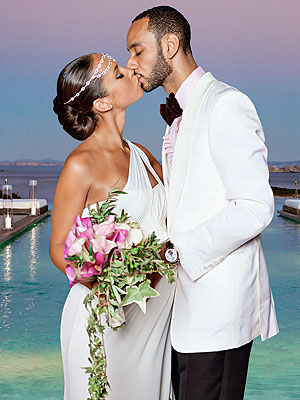
Alicia Keys looked stunning with her covered baby bump in a Greek goddess-inspired wedding gown by Vera Wang. Her hair was slicked back in a knot/bun with a gorgeous beaded headband draped across her forehead.
Not to be out done, Swizz wore a Tom Ford tuxedo. His tux seemed to be vintage inspired with a white jacket, ruffled shirt, black bow tie and black dress pants. Overall a classy look for a classic wedding.
Two photos have been spotted with the newlyweds. The first is brought to you by People Magazine. You see a classic bride and groom pose of them kissing with the beautiful sea. It kind of looks like a backdrop, but we're pretty sure it's real. Maybe it was used to distract people from knowing where the wedding took place.
Alicia Keys, 29, and Swizz Beatz, 31, took advantage of the media craziness over Chelsea Clinton's wedding and were married quietly over this past weekend. See photos of the beautiful pair.
The magical affair is speculated to have taken place near the Mediterranean Sea at a private home on Sunday.
Alicia Keys looked stunning with her covered baby bump in a Greek goddess-inspired wedding gown by Vera Wang. Her hair was slicked back in a knot/bun with a gorgeous beaded headband draped across her forehead.
Not to be out done, Swizz wore a Tom Ford tuxedo. His tux seemed to be vintage inspired with a white jacket, ruffled shirt, black bow tie and black dress pants. Overall a classy look for a classic wedding.
Two photos have been spotted with the newlyweds. The first is brought to you by People Magazine. You see a classic bride and groom pose of them kissing with the beautiful sea. It kind of looks like a backdrop, but we're pretty sure it's real. Maybe it was used to distract people from knowing where the wedding took place.
Jimmie Johnson said he was bump drafting Kurt Busch, like Busch wanted.
ESPN announcer Dale Jarrett said Johnson didn’t mean to bump draft.
How does a driver bump draft, but not mean to bump draft?
Barreling down the front stretch, mixing it up with Busch and Clint Bowyer, Johnson ran up behind Busch, and as he said, intended to bump draft, like Busch wanted him to do.
A four time champion should know two things in this situation. Bump drafting is intentional, and bump drafting while changing lanes, (Johnson was moving left when he hit Busch), is not bump drafting at all, it’s crashing the other driver.
The end result of Johnson’s veiled bump drafting was Busch taking a hard right turn into the wall, on a straightaway, and Johnson moving on.
The ripple effects of Johnson’s unintentional bump drafting were a few other cars checking up and taking evasive action to avoid the unfolding crash.
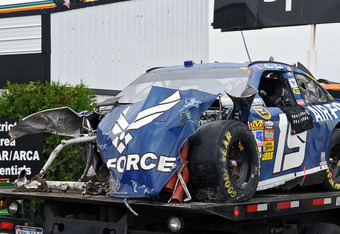
While the car of Kurt Busch was all but destroyed, it was the No.19 of Elliott Sadler that suffered the most.
After checking up to avoid the crash, Sadler’s car was hit from behind and catapulted across the infield grass.
Sadler’s car crashed head-on into the pocket of an “L” shaped infield barrier. The resulting impact caused the complete front end of Sadler’s car to dislodge, ripping the engine from its mounting bolts and slinging it across the track.
Johnson did say on the radio that he might have caused that and to tell those guys he was sorry.
Sorry should be the adjective used to describe Johnson’s driving. The four time champion has been vocal, and critical, on the radio, and in the media, many times before about how other drivers take too many chances when racing close to him. His latest well publicized issues were with his teammate and boss Jeff Gordon.
Those complaints obviously fall on deaf ears when it comes to Johnson being the aggressor.
Sorry could also be used to describe how Pocono Raceway and the Mattiolli’s have handled the multiple safety issues surrounding the tricky triangle.
Just over six weeks ago, during Pocono’s June race, Kasey Kahne was involved in a late race incident that saw his car getting airborne. The absence of a catch fence allowed Kahne’s car to fly into the trees surrounding the raceway.
Pocono President Brandon Igdalsky has promised the track will make some changes and upgrades to address the safety issues. He also stated that most of these changes would have to take place after the second race because of such a short time in between events. Both races at Pocono are held just six short weeks apart.
There is speculation that NASCAR has already decided on its schedule for next year.
If they have not, then one issue they should take into consideration is the fact that a short turnaround between events can place severe limitations on any issues involving the sport, especially safety issues.
Pocono has the shortest amount of time between events of all the tracks that host multiple races.
If NASCAR has already finalized next year’s schedule, then there is plenty of time to take these safety issues and time constraints under advisement for the 2012 season.
Johnson’s actions single handedly wiped out three of the four cars fielded by Richard Petty Motorsports.
In this case NASCAR’s dedication to safety in the cars is what might have saved Elliott Sadler’s life.
Pocono’s lack of action, for the second time in a row, almost caused a tragedy.
Jimmie Johnson said he was bump drafting Kurt Busch, like Busch wanted.
ESPN announcer Dale Jarrett said Johnson didn’t mean to bump draft.
How does a driver bump draft, but not mean to bump draft?
Barreling down the front stretch, mixing it up with Busch and Clint Bowyer, Johnson ran up behind Busch, and as he said, intended to bump draft, like Busch wanted him to do.
A four time champion should know two things in this situation. Bump drafting is intentional, and bump drafting while changing lanes, (Johnson was moving left when he hit Busch), is not bump drafting at all, it’s crashing the other driver.
The end result of Johnson’s veiled bump drafting was Busch taking a hard right turn into the wall, on a straightaway, and Johnson moving on.
The ripple effects of Johnson’s unintentional bump drafting were a few other cars checking up and taking evasive action to avoid the unfolding crash.
While the car of Kurt Busch was all but destroyed, it was the No.19 of Elliott Sadler that suffered the most.
After checking up to avoid the crash, Sadler’s car was hit from behind and catapulted across the infield grass.
Sadler’s car crashed head-on into the pocket of an “L” shaped infield barrier. The resulting impact caused the complete front end of Sadler’s car to dislodge, ripping the engine from its mounting bolts and slinging it across the track.
Johnson did say on the radio that he might have caused that and to tell those guys he was sorry.
Sorry should be the adjective used to describe Johnson’s driving. The four time champion has been vocal, and critical, on the radio, and in the media, many times before about how other drivers take too many chances when racing close to him. His latest well publicized issues were with his teammate and boss Jeff Gordon.
Those complaints obviously fall on deaf ears when it comes to Johnson being the aggressor.
Sorry could also be used to describe how Pocono Raceway and the Mattiolli’s have handled the multiple safety issues surrounding the tricky triangle.
Just over six weeks ago, during Pocono’s June race, Kasey Kahne was involved in a late race incident that saw his car getting airborne. The absence of a catch fence allowed Kahne’s car to fly into the trees surrounding the raceway.
Pocono President Brandon Igdalsky has promised the track will make some changes and upgrades to address the safety issues. He also stated that most of these changes would have to take place after the second race because of such a short time in between events. Both races at Pocono are held just six short weeks apart.
There is speculation that NASCAR has already decided on its schedule for next year.
If they have not, then one issue they should take into consideration is the fact that a short turnaround between events can place severe limitations on any issues involving the sport, especially safety issues.
Pocono has the shortest amount of time between events of all the tracks that host multiple races.
If NASCAR has already finalized next year’s schedule, then there is plenty of time to take these safety issues and time constraints under advisement for the 2012 season.
Johnson’s actions single handedly wiped out three of the four cars fielded by Richard Petty Motorsports.
In this case NASCAR’s dedication to safety in the cars is what might have saved Elliott Sadler’s life.
Pocono’s lack of action, for the second time in a row, almost caused a tragedy.
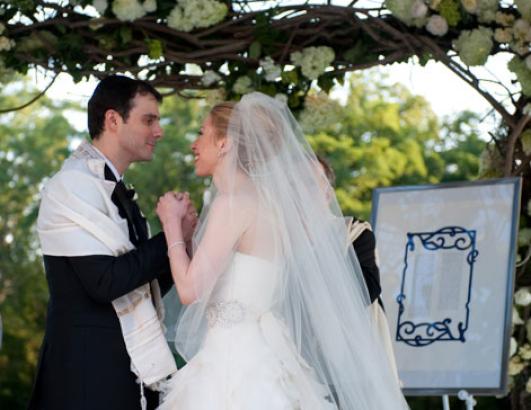
Chelsea Clinton's wedding has been talked about for some time mainly because of all the secrecy and privacy surrounding the intimate ceremony. The reason for this is that people and paparazzi alike want to get their hands on a couple of Chelsea Clinton's wedding photos.
Rhinebeck, New York will have a giant microscope placed on them this weekend because that is where Chelsea Clinton will exchange vows with her childhood friend and soon to be husband,Marc Mezvinsky in front of 500 guests. Former President Bill Clinton and U.S. Secretary of State Hillary Clinton were on hand last night as they attended the rehearsal dinner for Chelsea's wedding. This will be a great day for former President Clinton. Fathers everywhere dream of the day when they get to walk down the aisle with their daughter and give them away to a lucky man and sometimes woman! Take a look at all the guests, fans and family arriving at the rehearsal dinner.


Chelsea Clinton's wedding has been talked about for some time mainly because of all the secrecy and privacy surrounding the intimate ceremony. The reason for this is that people and paparazzi alike want to get their hands on a couple of Chelsea Clinton's wedding photos.
Rhinebeck, New York will have a giant microscope placed on them this weekend because that is where Chelsea Clinton will exchange vows with her childhood friend and soon to be husband,Marc Mezvinsky in front of 500 guests. Former President Bill Clinton and U.S. Secretary of State Hillary Clinton were on hand last night as they attended the rehearsal dinner for Chelsea's wedding. This will be a great day for former President Clinton. Fathers everywhere dream of the day when they get to walk down the aisle with their daughter and give them away to a lucky man and sometimes woman! Take a look at all the guests, fans and family arriving at the rehearsal dinner.
There have been reams of speculation about just how private Chelsea Clinton wants her marriage to Marc Mezvinsky to be this weekend in Rhinebeck, N.Y.
Private, semi-private, really not private at all — but feigning a desire for privacy. When you have to invite several hundred people to please the relatives or the company or Congress before you've invited even one friend from grade school, your wedding has about as much intimacy as Times Square on New Year's Eve.
Almost six years ago, getting married for the first time, I realized that I would have to invite 175 of my husband's beloved Irish-American relatives to our nuptials before I had even one friend or relative of my own on the guest list. These people were all dearly welcome, but we just couldn't afford a 300-person wedding and, to be honest, didn't want one. I just didn't want to look out at a sea of humanity on my wedding day.
Our solution was to go across the sea, then, to Ireland — where we both had friends and family — marry there, and invite everyone. About 100 die-hards made it to the ceremony. We celebrated all night long, with the bartender and the musicians slumped over glasses of Guinness come morning.
But that won't work for Chelsea and Marc. Irish bookies at Paddy Power are taking bets on everything from who will be the first to cry at the ceremony to the length of Bill Clinton's speech. Bill is also "tipped for tears" as the first to cry. It's all meant to be amusing, of course, but I find it depressing. For us, Ireland was a sanctuary. But we aren't celebrities.
Weddings are increasingly notable for their amazing lack of intimacy, their evolution into industry. Especially for celebrities, they've evolved into must-haves and appointment-list mega-spectacles. I'd be surprised if some part of Chelsea Clinton doesn't want to just kick over the traces, start again and elope on horseback with her bridegroom.
I’m sure she'll have — I hope they'll both have — a great day, a day that's more than a blur, but I know we'll all be expecting the pictures, if not a bite of the cake. Perhaps we should all have two weddings — one for the public, friends and family, and posterity. And the other — some ceremony under a tree, nobody there but a faun playing a flute. No pictures, just us, Orpheus and Eurydice.
